Synthetic — validation only
Results
Learning & dynamics
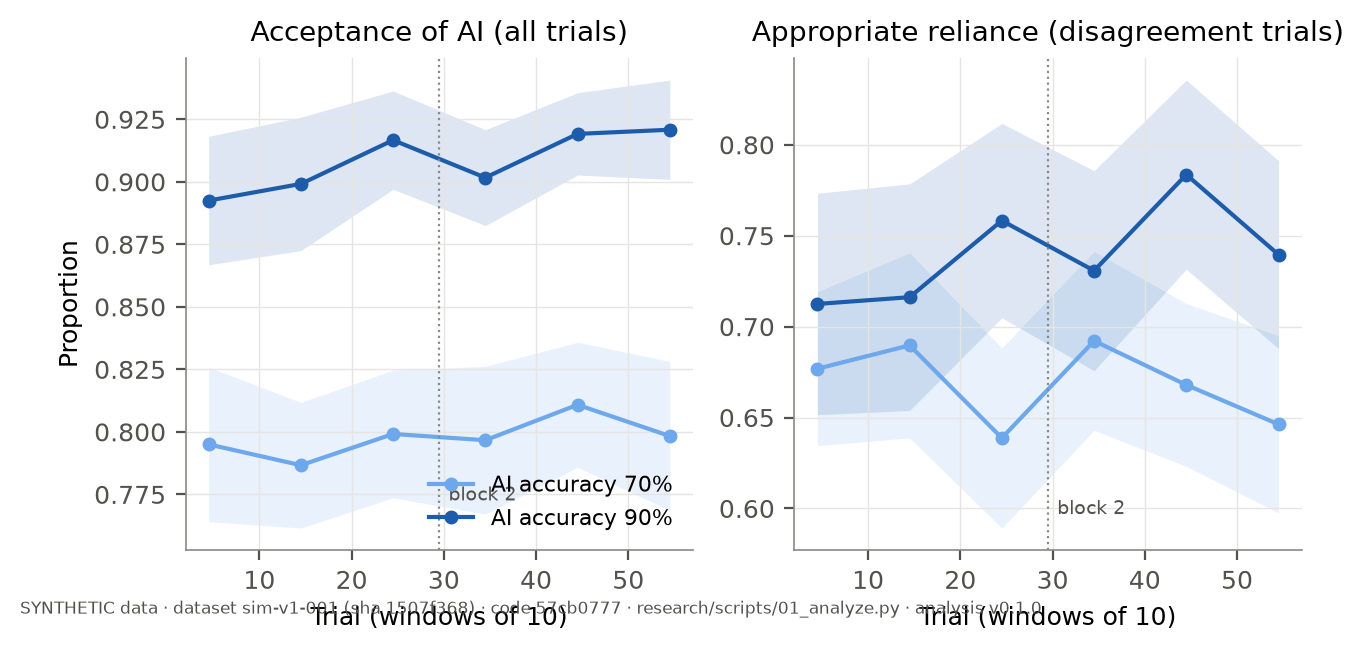
How reliance changes over the course of a session, and how consistent that pattern is across participants.
Trust trajectory over the session
Synthetic — validation onlydataset sim-v1-001 · sha 1507f368 · code 57cb0777+ · research/scripts/01_analyze.py · v0.1.0
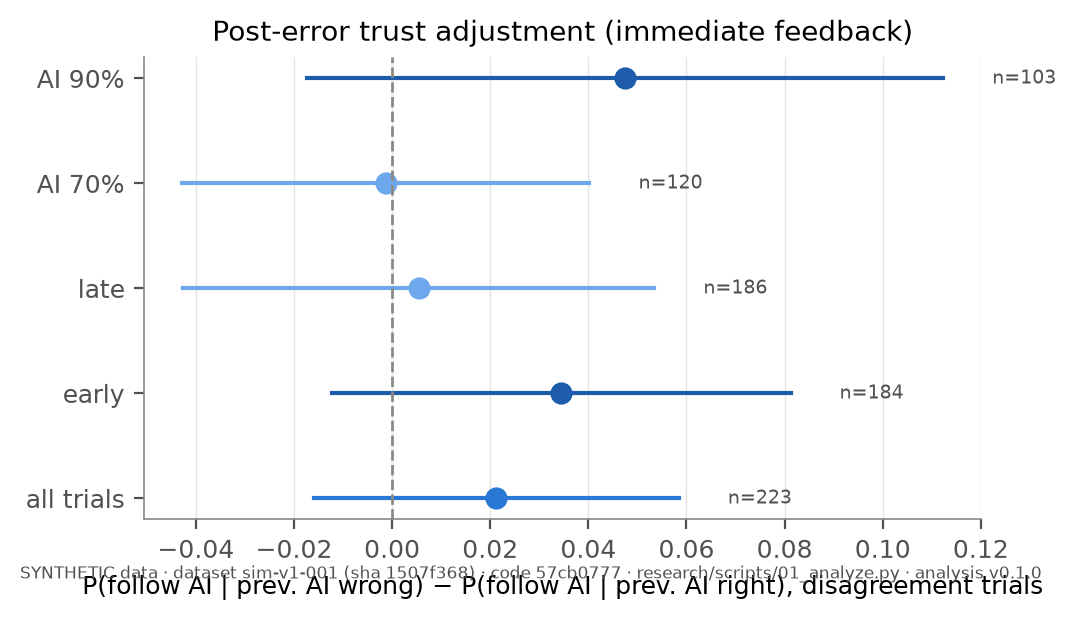
Post-error trust adjustment
Synthetic — validation onlydataset sim-v1-001 · sha 1507f368 · code 57cb0777+ · research/scripts/01_analyze.py · v0.1.0
Post-error adjustment, overall (disagreement trials, immediate feedback)
2.1% [-1.6%, 5.8%] · one-sample t = 1.13, p = 0.262
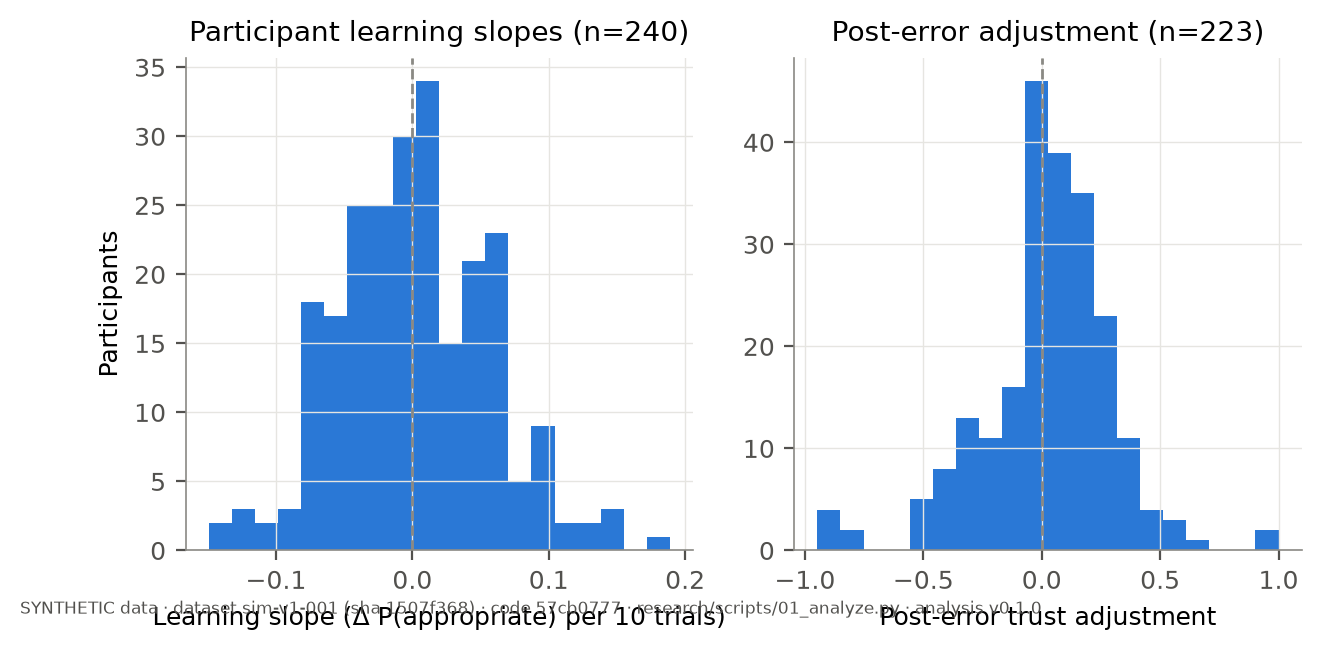
Participant heterogeneity
Synthetic — validation onlydataset sim-v1-001 · sha 1507f368 · code 57cb0777+ · research/scripts/01_analyze.py · v0.1.0
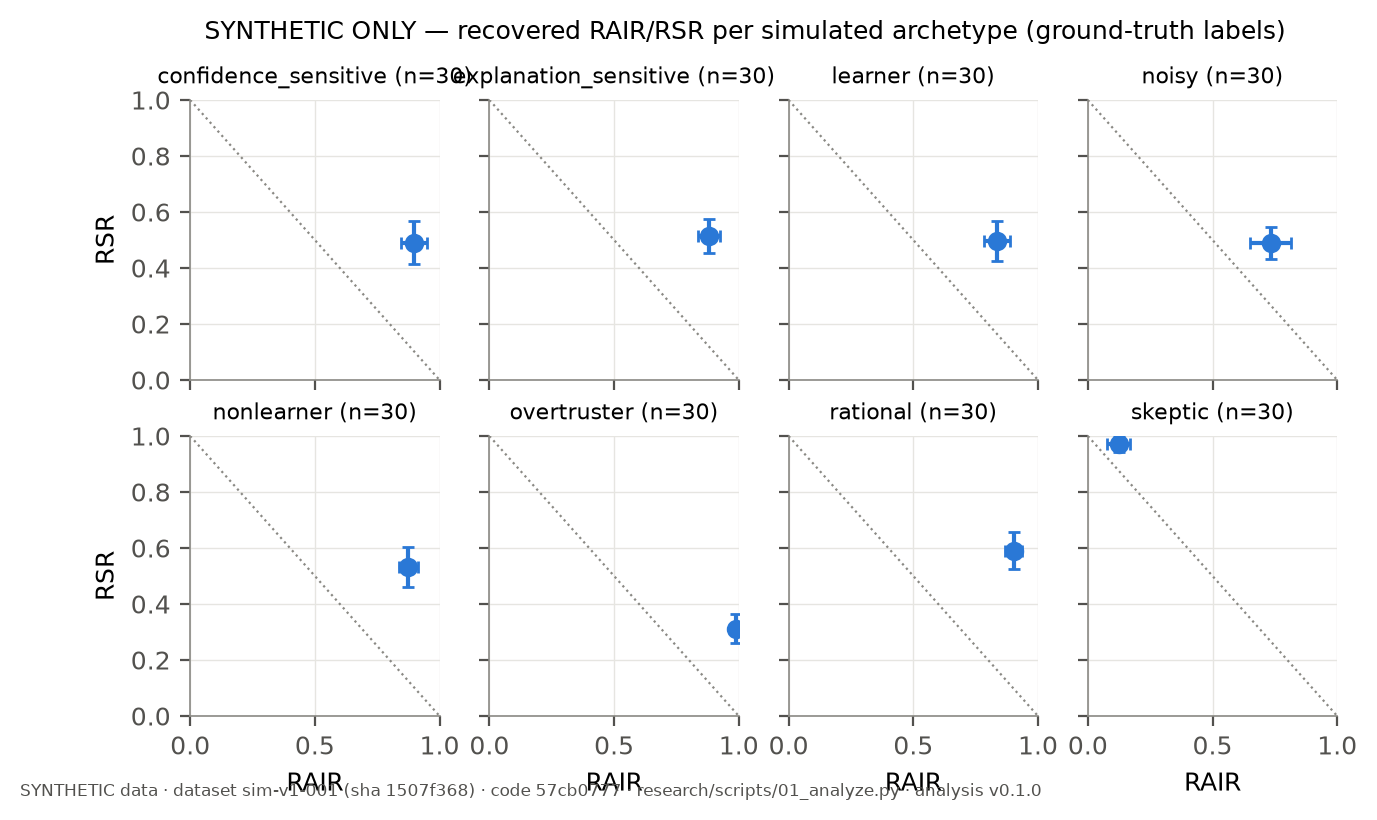
Recovered reliance by simulated archetype (synthetic only)
Synthetic — validation onlydataset sim-v1-001 · sha 1507f368 · code 57cb0777+ · research/scripts/01_analyze.py · v0.1.0
What "learning" means here
The learning slope is the within-participant trend in appropriate reliance (following a correct AI, or overriding a wrong one) across a session's disagreement trials — not raw accuracy, which is dominated by task difficulty. A slope near zero over 60 trials is not surprising; it is the reason this design pairs a short session with feedback conditions in the second experiment (v2) rather than expecting large within-session learning in v1. See methods.