Synthetic — validation only
Results
Reliance
Acceptance, and the two components of appropriate reliance: RAIR (following the AI when it's right) and RSR (keeping your own answer when the AI is wrong).
RAIR by AI-accuracy arm
Synthetic — validation onlydataset sim-v1-001 · sha 1507f368 · code 57cb0777+ · research/scripts/01_analyze.py · v0.1.0
RSR by AI-accuracy arm
Synthetic — validation onlydataset sim-v1-001 · sha 1507f368 · code 57cb0777+ · research/scripts/01_analyze.py · v0.1.0
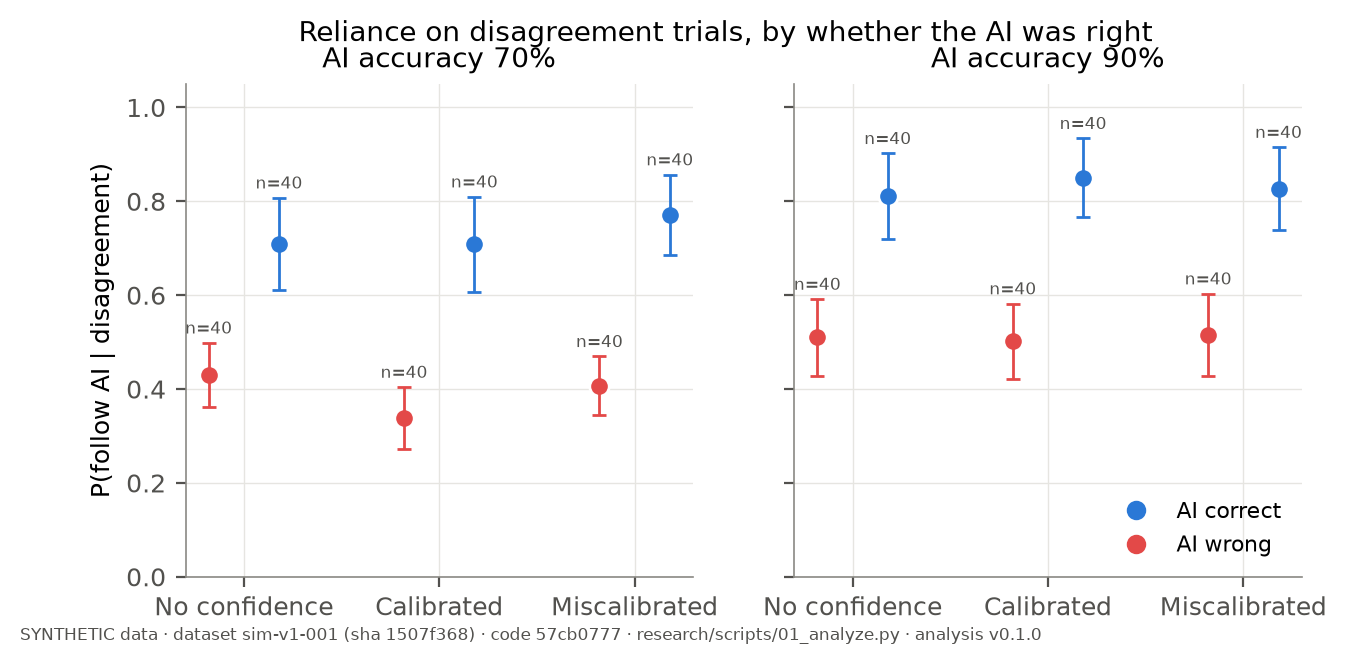
Reliance on disagreement trials, by AI correctness
Synthetic — validation onlydataset sim-v1-001 · sha 1507f368 · code 57cb0777+ · research/scripts/01_analyze.py · v0.1.0
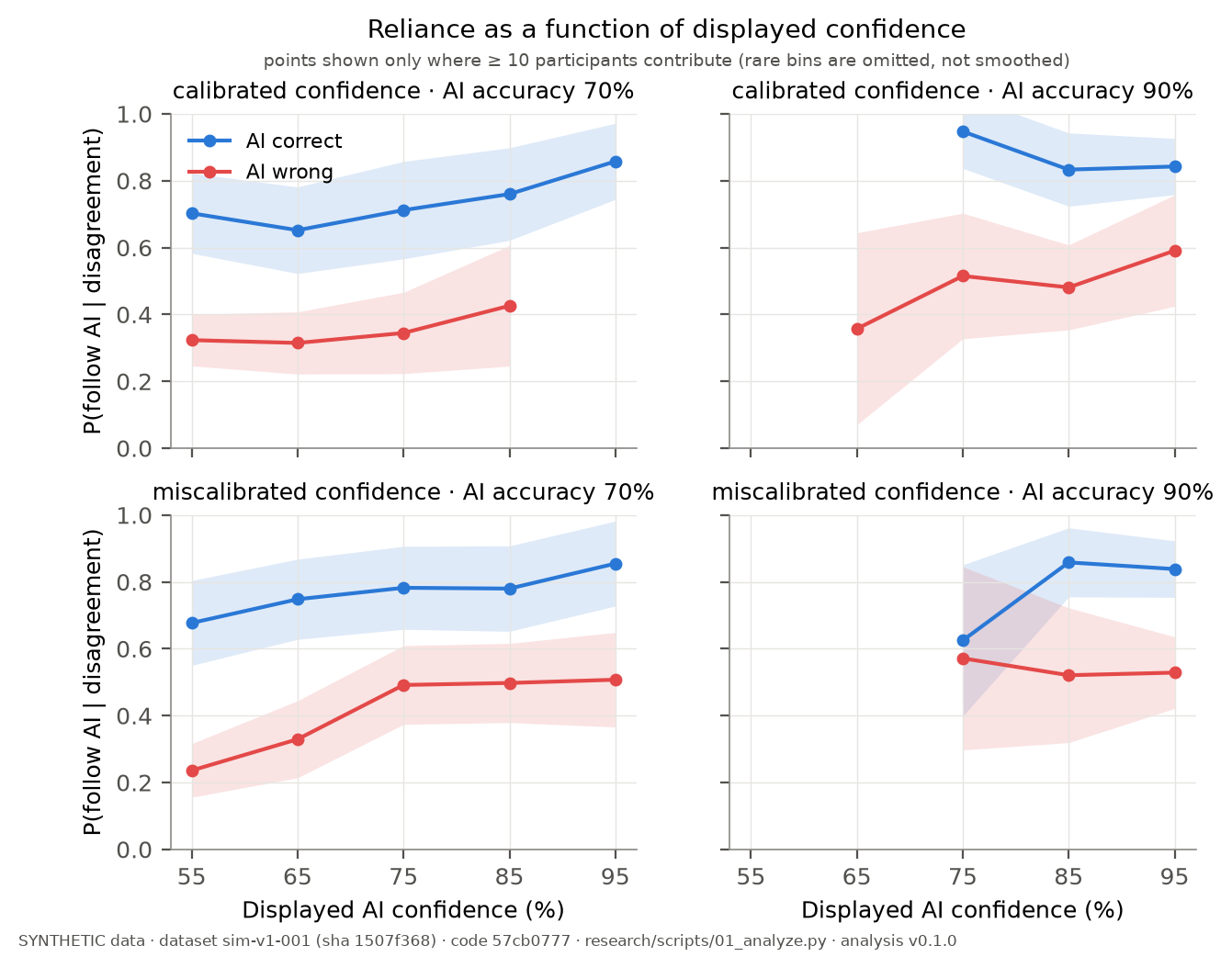
Reliance as a function of displayed AI confidence
Synthetic — validation onlydataset sim-v1-001 · sha 1507f368 · code 57cb0777+ · research/scripts/01_analyze.py · v0.1.0
Over-reliance rate on wrong AI recommendations, by displayed confidence
| Display arm | Error type | Over-reliance rate | n trials |
|---|---|---|---|
| calibrated | uncertain wrong | 35.0% | 572 |
| calibrated | confidently wrong | 51.2% | 168 |
| miscalibrated | uncertain wrong | 36.0% | 367 |
| miscalibrated | confidently wrong | 52.2% | 343 |
Reading these numbers
RAIR and RSR are defined only on disagreement trials — where a participant's first answer differed from the AI's recommendation — because that is the only situation in which "following the AI" is behaviourally distinguishable from "having agreed with it already." Formal definitions are in methods.